Architecture Deep Dive
Overview
The Engram platform implements a Brain + Spine architecture pattern, separating cognitive reasoning (Brain) from durable execution (Spine), with a persistent memory layer providing long-term knowledge storage.
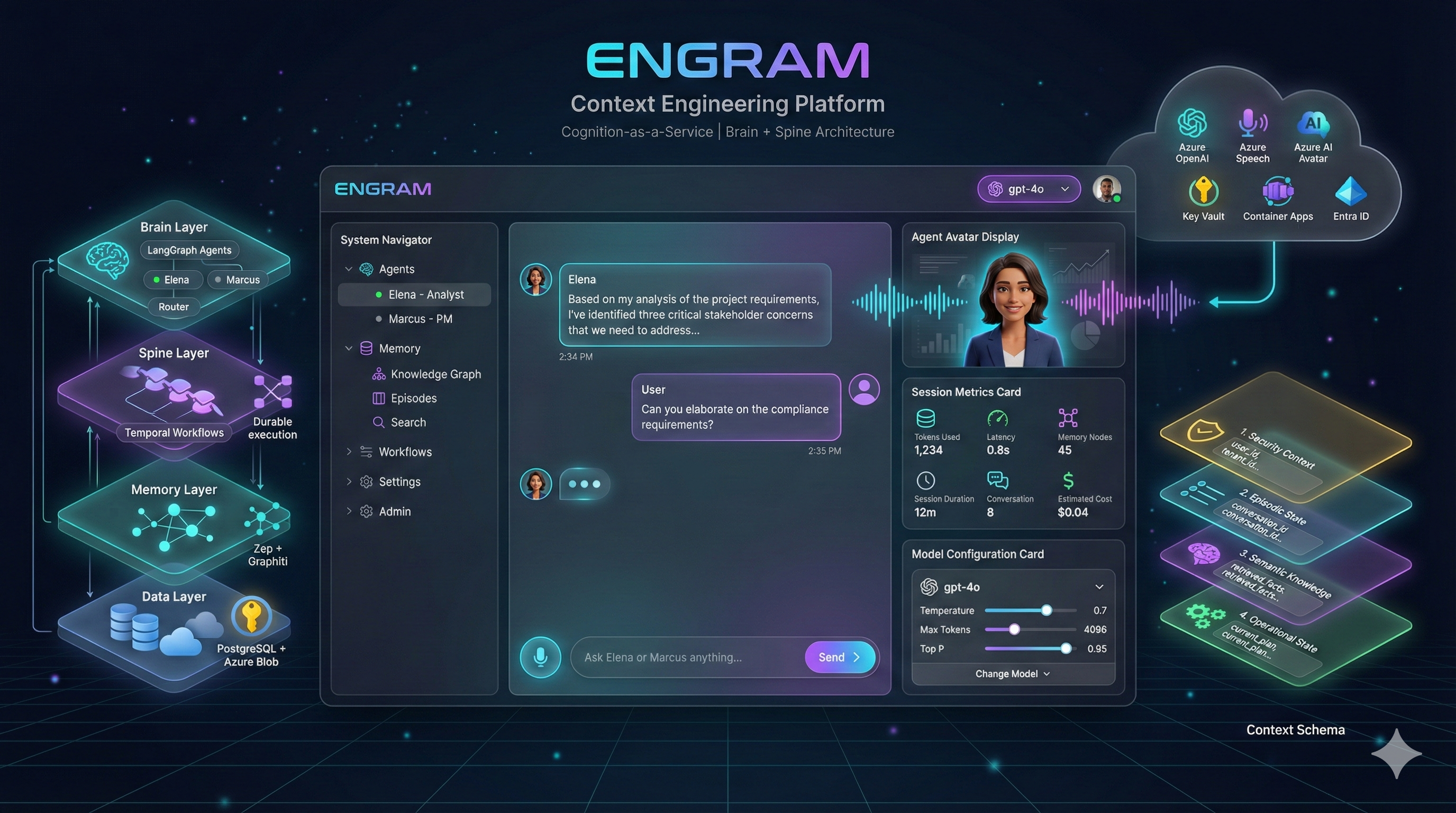
Core Principles
1. Context Engineering over Prompt Engineering
Traditional prompt engineering focuses on crafting individual prompts. Context Engineering takes a holistic view:
| Aspect | Prompt Engineering | Context Engineering |
|---|---|---|
| Focus | Single prompt | Full context lifecycle |
| State | Stateless | Stateful across sessions |
| Memory | Limited context window | Unlimited via external memory |
| Security | Ad-hoc | Built into context schema |
2. Brain + Spine Separation
| Component | Brain (LangGraph) | Spine (Temporal) |
|---|---|---|
| Purpose | Reasoning & decisions | Durable execution |
| Lifecycle | Stateless functions | Long-running workflows |
| Failure | Retry at LLM level | Workflow-level recovery |
| Scale | Horizontal (replicas) | Workflow distribution |
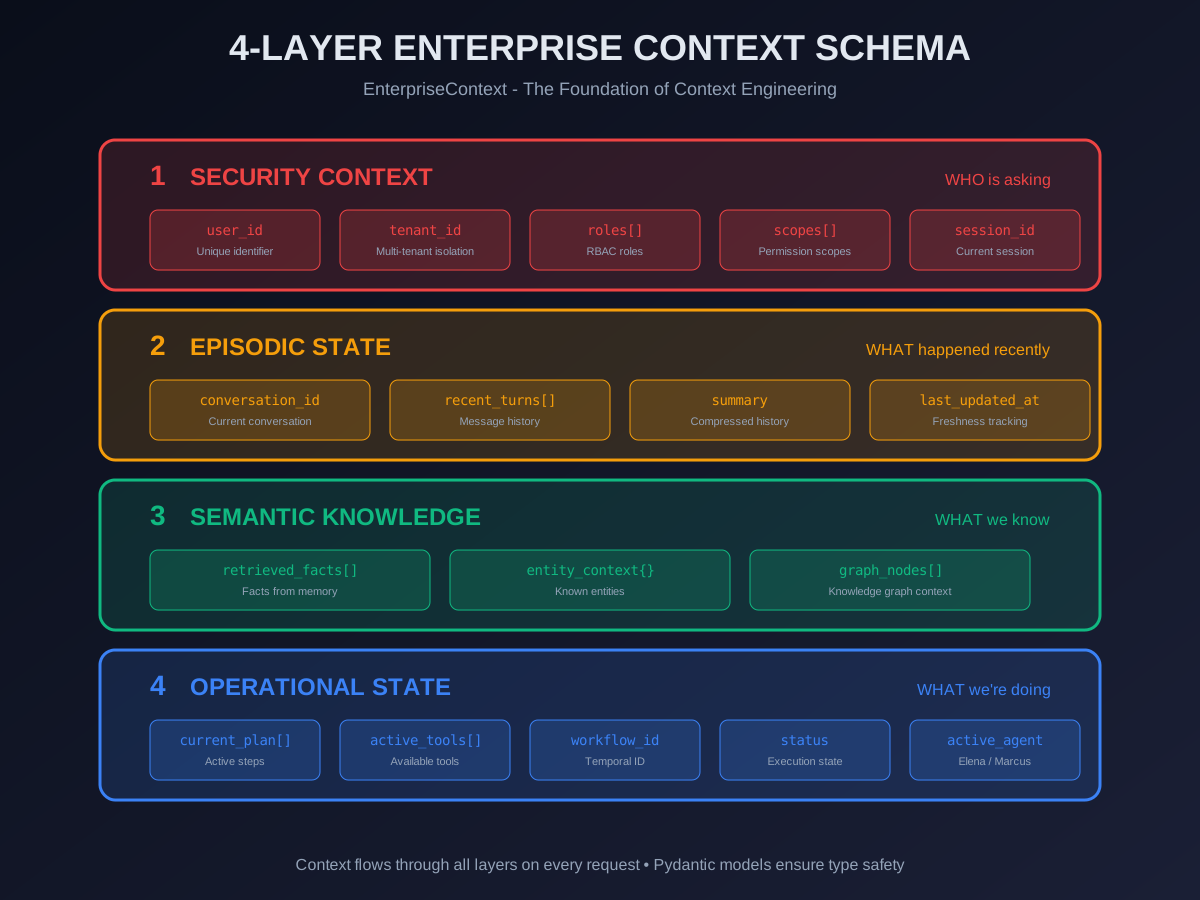
The 4-Layer Context Schema
Every interaction in Engram flows through a structured context object:
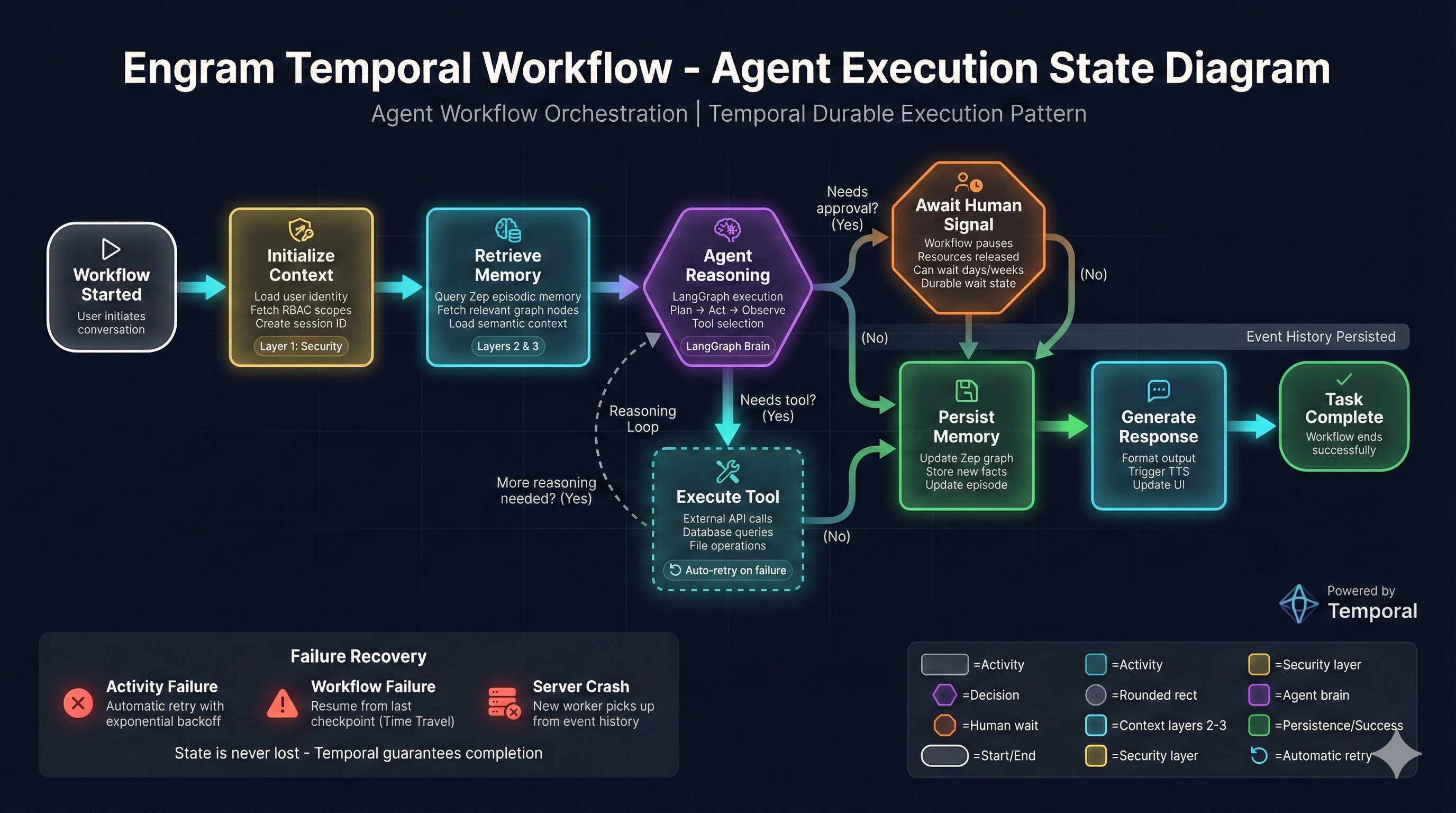
Temporal Workflow Execution
Layer 1: Security Context
class SecurityContext(BaseModel):
    user_id: str           # Unique user identifier
    tenant_id: str         # Multi-tenant isolation
    roles: List[Role]      # RBAC roles (ADMIN, MANAGER, ANALYST, VIEWER)
    scopes: List[str]      # Permission scopes
    session_id: str        # Current session
Purpose: Establishes WHO is making the request and WHAT they can access.
Layer 2: Episodic State
class EpisodicState(BaseModel):
    conversation_id: str              # Current conversation
    recent_turns: List[ConvTurn]      # Recent message history
    summary: Optional[str]            # Compressed history
    last_updated_at: datetime         # Freshness tracking
Purpose: Captures WHAT happened in the current and recent conversations.
Layer 3: Semantic Knowledge
class SemanticKnowledge(BaseModel):
    retrieved_facts: List[Fact]       # Relevant facts from memory
    entity_context: Dict[str, Any]    # Known entities and relationships
    graph_nodes: List[GraphNode]      # Knowledge graph context
Purpose: Provides WHAT we know from long-term memory.
Layer 4: Operational State
class OperationalState(BaseModel):
    current_plan: List[str]           # Active plan steps
    active_tools: List[str]           # Available tools
    workflow_id: Optional[str]        # Temporal workflow ID
    status: str                       # Current execution status
    active_agent: Optional[str]       # Current agent (elena/marcus)
Purpose: Tracks WHAT we’re doing right now.
Component Architecture
Brain Layer: LangGraph Agents
┌─────────────────────────────────────────────────────┐
│                    Agent Router                      │
│  ┌─────────────┐           ┌─────────────┐         │
│  │   Elena     │   ←────→  │   Marcus    │         │
│  │  (Analyst)  │  handoff  │  (Manager)  │         │
│  └─────────────┘           └─────────────┘         │
│         │                         │                 │
│         └───────────┬─────────────┘                 │
│                     │                               │
│              ┌──────┴──────┐                        │
│              │   Tools     │                        │
│              │ - analyze   │                        │
│              │ - plan      │                        │
│              │ - report    │                        │
│              └─────────────┘                        │
└─────────────────────────────────────────────────────┘
Each agent is a LangGraph state machine with:
- System prompt defining persona and expertise
- Tools for specialized operations
- State management via EnterpriseContext
Spine Layer: Temporal Workflows
┌─────────────────────────────────────────────────────┐
│                AgentWorkflow                         │
├─────────────────────────────────────────────────────┤
│  1. initialize_context_activity                      │
│  2. enrich_memory_activity                          │
│  3. agent_reasoning_activity  ← Brain execution     │
│  4. validate_response_activity                      │
│  5. persist_memory_activity                         │
└─────────────────────────────────────────────────────┘

┌─────────────────────────────────────────────────────┐
│              ConversationWorkflow                    │
├─────────────────────────────────────────────────────┤
│  - Long-running (can span days)                     │
│  - Signals: send_message, switch_agent              │
│  - Queries: get_history, get_turn_count            │
│  - Child workflows for each turn                    │
└─────────────────────────────────────────────────────┘
Key Benefits:
- Survives crashes and restarts
- Automatic retry with backoff
- Human-in-the-loop via signals
- Time-travel debugging
Memory Layer: Zep + Graphiti
┌─────────────────────────────────────────────────────┐
│                    Zep Service                       │
├─────────────────────────────────────────────────────┤
│  ┌─────────────┐         ┌─────────────┐           │
│  │  Episodic   │         │  Semantic   │           │
│  │   Memory    │         │   Memory    │           │
│  │ (sessions)  │         │  (Graphiti) │           │
│  └─────────────┘         └─────────────┘           │
│         │                       │                   │
│         └───────────┬───────────┘                   │
│                     │                               │
│              ┌──────┴──────┐                        │
│              │  PostgreSQL │                        │
│              │  + pgvector │                        │
│              └─────────────┘                        │
└─────────────────────────────────────────────────────┘
Episodic Memory (Layer 2):
- Conversation history by session
- Automatic summarization
- Temporal retrieval
Semantic Memory (Layer 3):
- Knowledge graph via Graphiti
- Entity relationships
- Fact extraction and storage
Data Flow
Request Lifecycle
User Request
     │
     ▼
┌─────────────┐
│  FastAPI    │ ── Auth + RBAC
│   Gateway   │
└─────────────┘
     │
     ▼
┌─────────────┐
│  Temporal   │ ── Start workflow
│   Client    │
└─────────────┘
     │
     ▼
┌─────────────┐
│   Worker    │ ── Execute activities
└─────────────┘
     │
     ├──► Memory Enrichment (Zep)
     │
     ├──► Agent Reasoning (LangGraph)
     │
     ├──► Response Validation
     │
     └──► Memory Persistence (Zep)
     │
     ▼
Response to User
Voice Interaction Flow (removed)
Voice features are disabled in the current build; no Speech or VoiceLive paths are deployed.
Security Architecture
Authentication Flow
User ──► Entra ID ──► JWT Token ──► API Gateway ──► Validate ──► SecurityContext
Authorization (RBAC)
| Resource | Admin | Manager | Analyst | Viewer |
|---|---|---|---|---|
| Agents | CRUD + Execute | Read + Execute | Read + Execute | Read |
| Chat | CRUD + Execute | Create + Execute | Create + Execute | Read |
| Memory | CRUD + Admin | Create + Read | Create + Read | Read |
| Workflows | CRUD + Execute | CRUD + Execute | Read + Execute | Read |
| Settings | Admin | Read | Read | - |
Tenant Isolation
- All data is tenant-scoped
- Cross-tenant access denied by default
- Admin override for platform operations
Observability
Distributed Tracing
Request ──► Span: API Gateway
              │
              └──► Span: Workflow Execution
                     │
                     ├──► Span: Memory Enrichment
                     │
                     └──► Span: Agent Reasoning
                            │
                            └──► Span: LLM Call
Metrics Collected
| Metric | Type | Labels |
|---|---|---|
http_requests_total | Counter | method, path, status |
agent_executions_total | Counter | agent_id, status |
agent_tokens_total | Counter | agent_id, model |
workflow_duration_seconds | Histogram | workflow_type |
memory_search_duration_seconds | Histogram | operation |
Log Correlation
All logs include:
trace_id: OpenTelemetry trace IDspan_id: Current span IDuser_id: Authenticated usertenant_id: Active tenant
Table of contents
- Agent & User Isolation with Project-Based Access Control
- Azure AI Foundry Agent Service Integration
- Foundry Agent Service Integration - Impact Analysis
- Foundry Agent Service POC - Implementation Summary
- Foundry Thread Integration - Complete
- Using Foundry-Created Agents in Engram
- Elena Foundry Migration Guide
- Configuration Source of Truth Strategy
- Foundry Configuration Setup - Source of Truth
- Additional Foundry Features We Can Leverage
- Foundry Features Roadmap
- Elena Foundry Migration - Complete
- Elena Tool Endpoints - Configured
- Elena Avatar Configuration - Azure AI Foundry
- Elena Avatar Frontend Integration
- Multi-Agent Orchestration Research - Foundry Integration
- Microsoft 365 Integration Research - Teams & Outlook
- VoiceLive Avatar Integration
- VoiceLive Avatar Integration Complete
- Foundry IQ POC Implementation
- Foundry IQ Integration Summary
- AI Periodic Table Analysis
- AI Periodic Table Matrix
- Agent Personas
- Agentic System Maturity Assessment
- Authentication & Security Architecture
- Authentication Architecture Evolution
- Authentication Configuration Verification
- Comprehensive User Identity Flow Architecture
- Diagrams Directory
- Engram Authentication Architecture Analysis
- Engram Memory Architecture: Zep & Agents
- Engram System Architecture & Migration Context
- Enterprise Authentication Strategy: From POC to Production
- Enterprise Env Model
- Entra External ID Authentication
- Memory Enrichment Workflow: Sessions, Episodes, Stories, and Chat
- SecurityContext: The Foundation of Enterprise Identity & Attribution
- Sessions vs Episodes: Clarifying the Distinction
- System Navigator
- The 4-Layer Context Schema: A Complete Story
- The Brain & Spine: Engram's Context Engineering Architecture
- The Self-Enriching Workflow: Recursive Engineering
- User Identity Fixes Required
- User Identity Flow - Executive Summary
- VoiceLive Failsafe Token Generation
- VoiceLive Failsafe Token Generation - Breakthrough Summary
- VoiceLive v2 Architecture Diagram