Document Ingestion Strategy: Enterprise Guide
Engram Context Engineering Platform
Aligns with GTM Research Paper v2 Pilot Requirements
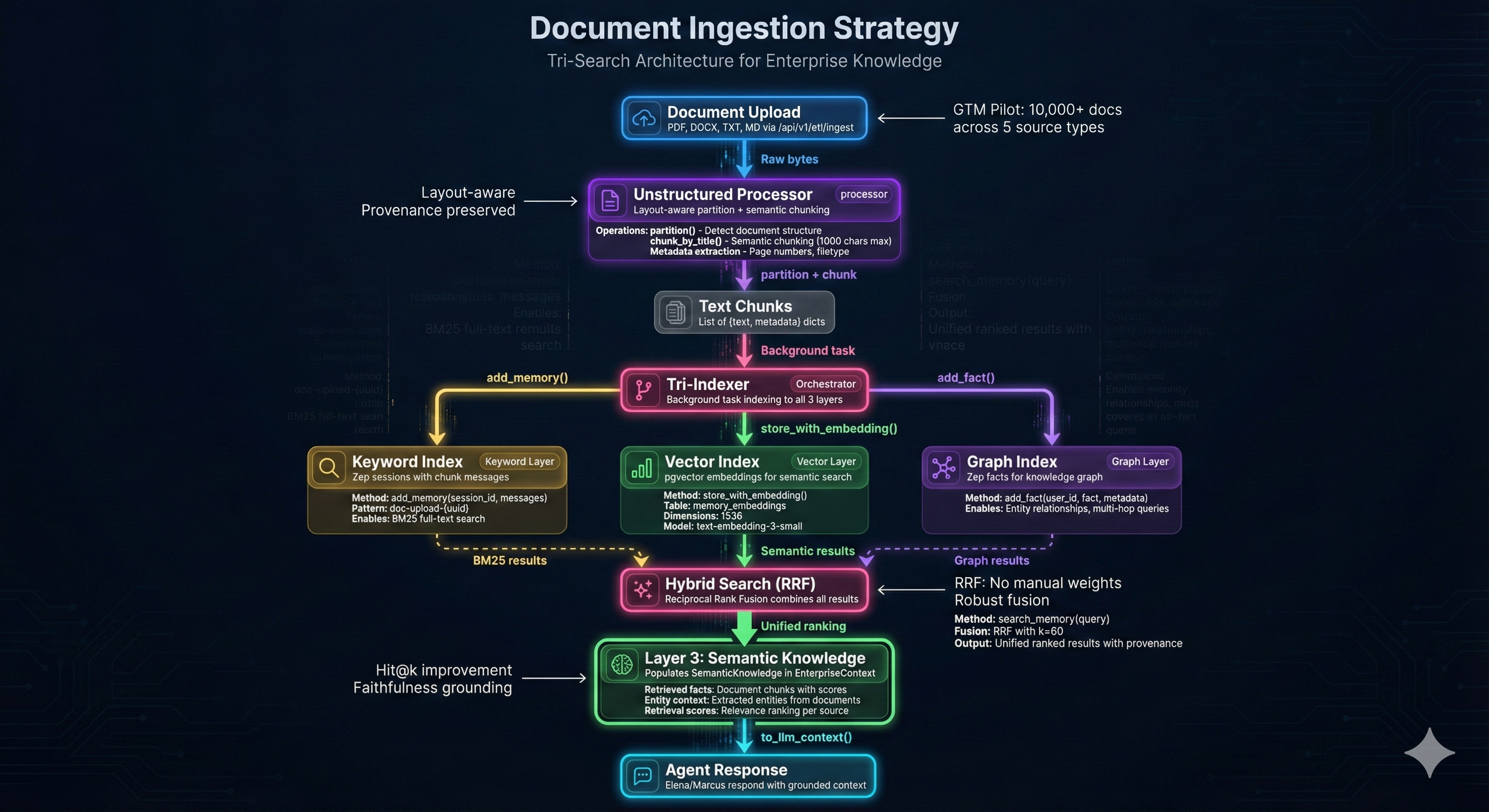
Executive Summary
The Engram Document Ingestion Strategy enables enterprises to ingest documents from 5 source types into a unified context engine, making content searchable via tri-search (keyword, vector, graph). This architecture directly addresses the GTM pilot requirements from the Context Engineering Research Paper.
GTM Alignment: 5 Pilot Source Types
| Source Type | GTM Requirement | Engram Implementation | Status |
|---|---|---|---|
| Policies | Governance docs, procedures | Unstructured PDF/DOCX → Tri-index | ✅ Implemented |
| Tickets | Issue trackers, case records | API connectors → Session episodes | 🔶 Planned |
| PDFs | Dense documents, reports | Unstructured partition → Chunking | ✅ Implemented |
| Wikis | Knowledge bases, Confluence | Wiki connector → doc-wiki-* sessions | ✅ Implemented |
| Code | Source files, configs | Git integration → Code-aware chunking | 🔶 Planned |
Antigravity Ingestion Router (CtxEco-Lib)
Context Ecology Architecture — Documents classified by Truth Value, routed to CtxGraph

The Antigravity Router replaces the generic Unstructured-for-everything approach with intelligent routing based on document type:
| Class | Name | Engine | Decay Rate | Use Case |
|---|---|---|---|---|
| A | Immutable Truth | IBM Docling | 0.01 | Safety manuals, specs, ISO docs |
| B | Ephemeral Chatter | Unstructured.io | 0.80 | Email, PPT, meeting notes |
| C | Operational | Pandas | 0.99 | CSV logs, JSON telemetry |
NIST SP 800-60 Classification
Every ingested document receives sensitivity classification:
- 🔴 High Impact — PII, safety-critical, credentials
- 🟡 Moderate Impact — Business confidential, specifications
- 🟢 Low Impact — General communications
16 Enterprise Connectors
| Category | Connectors |
|---|---|
| Cloud Storage | S3, Azure Blob, GCS |
| Collaboration | SharePoint, Drive, OneDrive, Confluence |
| Ticketing | ServiceNow, Jira, GitHub |
| Messaging | Slack, Teams, Email |
| Data | Database, Webhook, Local |
Tri-Search Architecture
Every ingested document is indexed into three search layers, enabling comprehensive retrieval via Reciprocal Rank Fusion (RRF):
1. Keyword Search (BM25/Lexical)
- Storage: Zep sessions with messages
- Session Pattern:
doc-upload-{uuid} - Enables: Exact phrase matching, acronym lookup
2. Vector Search (Semantic)
- Storage:
memory_embeddingstable (pgvector) - Embedding Model:
text-embedding-3-small(1536 dims) - Enables: Conceptual similarity, paraphrase matching
3. Graph Search (CtxGraph / OpenContextGraph)
- Storage: CtxGraph (Zep facts per user)
- Enables: Entity relationships, temporal facts, multi-hop reasoning (via OpenContextGraph API)
┌─────────────────────────────────────────────────────────────┐
│                    DOCUMENT UPLOAD                          │
│                  (PDF, DOCX, TXT, etc.)                     │
└─────────────────────────┬───────────────────────────────────┘
                          │
                          ▼
┌─────────────────────────────────────────────────────────────┐
│                 UNSTRUCTURED PROCESSOR                       │
│  • partition()     - Layout-aware extraction                 │
│  • chunk_by_title  - Semantic chunking (1000 char max)       │
│  • Metadata        - Page numbers, filetype, provenance      │
└─────────────────────────┬───────────────────────────────────┘
                          │
            ┌─────────────┼─────────────┐
            │             │             │
            ▼             ▼             ▼
┌───────────────┐ ┌─────────────┐ ┌─────────────┐
│   KEYWORD     │ │   VECTOR    │ │   GRAPH     │
│   LAYER       │ │   LAYER     │ │   LAYER     │
├───────────────┤ ├─────────────┤ ├─────────────┤
│ add_memory()  │ │ store_with_ │ │ add_fact()  │
│ to session    │ │ embedding() │ │ to user     │
│               │ │             │ │             │
│ Zep Sessions  │ │ pgvector    │ │ Zep Facts   │
│ `doc-upload-* │ │ memory_     │ │ Knowledge   │
│               │ │ embeddings  │ │ Graph       │
└───────────────┘ └─────────────┘ └─────────────┘
            │             │             │
            └─────────────┼─────────────┘
                          │
                          ▼
┌─────────────────────────────────────────────────────────────┐
│                    HYBRID SEARCH                             │
│            Reciprocal Rank Fusion (RRF)                      │
│  search_memory() combines all three result sets              │
└─────────────────────────────────────────────────────────────┘
Technical Implementation
Core Components
| Component | File | Purpose |
|---|---|---|
DocumentProcessor | backend/etl/processor.py | Unstructured partition + chunking |
IngestionService | backend/etl/ingestion_service.py | Tri-indexing orchestration |
ZepMemoryClient | backend/memory/client.py | Keyword + graph storage |
VectorStore | backend/memory/vector_store.py | Embedding storage + search |
EmbeddingClient | backend/memory/embedding_client.py | Azure OpenAI embeddings |
API Endpoint
POST /api/v1/etl/ingest
Content-Type: multipart/form-data

Parameters:
  file: <document binary>

Response:
{
  "success": true,
  "filename": "policy-v2.pdf",
  "chunks_processed": 42,
  "session_id": "doc-upload-a1b2c3d4",
  "document_id": "doc-e5f6g7h8i9j0"
}
Ingestion Flow (Background Task)
async def index_chunks_tri(chunks, user_id, filename, doc_id, session_id):
    # 1. Create session for keyword search
    await memory_client.get_or_create_session(
        session_id=session_id,
        user_id=user_id,
        metadata={"title": filename, "document_id": doc_id}
    )

    for chunk in chunks:
        # Layer 1: Graph (facts)
        await memory_client.add_fact(user_id, fact=chunk.text, metadata={...})

        # Layer 2: Vector (embeddings)
        await store_with_embedding(session_id, content=chunk.text, source_type="document")

        # Layer 3: Keyword (session messages)
        await memory_client.add_memory(session_id, messages=[...])
Context Layer Integration
Document ingestion populates Layer 3: Semantic Knowledge of the 4-Layer Enterprise Context Schema:
| Layer | Populated By | Document Role |
|---|---|---|
| Layer 1: Security | Azure Entra ID | User permissions filter document access |
| Layer 2: Episodic | Chat/Voice | Conversation about documents |
| Layer 3: Semantic | Document Ingestion | Facts and entities from documents |
| Layer 4: Operational | Temporal | Durable ingestion workflows |
Pilot Success Criteria (GTM Alignment)
From the GTM Research Paper, document ingestion supports:
Retrieval Metrics
- ✅ Hit@1/Hit@3: Tri-search improves first-result accuracy
- ✅ No-answer reduction: Graph relationships surface related content
Faithfulness Metrics
- ✅ Grounded responses: Facts include provenance metadata
- ✅ Citation correctness:
document_id+chunk_indexenable citations
Governance Metrics
- ✅ Audit logs: Ingestion logged with user_id, filename, timestamp
- ✅ Tenant isolation: User-scoped facts prevent cross-tenant leakage
Connector Roadmap
Phase 1: File Upload (Implemented)
- Manual upload via API/UI
- Supported: PDF, DOCX, TXT, MD
- Processing: Unstructured.io
Phase 2: Enterprise Connectors (Planned)
| Connector | Source Type | Priority |
|---|---|---|
| SharePoint | Policies, wikis | High |
| Confluence | Wikis | High |
| GitHub | Code | Medium |
| ServiceNow | Tickets | Medium |
| S3/Azure Blob | All | High |
Phase 3: Real-time Sync
- Webhook-based incremental updates
- Bi-temporal tracking (valid time + transaction time)
- Contradiction detection for updated facts